Saturday, 23 February 2013
Monday, 11 February 2013
Heating Systems
Heating Systems in UK
In the UK, various heating methods are provided with minimum cost. Gas is widely used in the UK as a heating method. A gas-fired boiler heats the water and to provide heat through radiators.
A more expensive method to heat is electricity. This involves night storage heates. These use electricity to heat special retaining-heat bricks which will keep homes warm for the day.
In some remote areas where homes are short of mains gas or areas where no main gas is provided, they can always tend to use LPG (Liquid Petrolium Gas). Like the mains gas, it heats the water and provides heat through radiators. Unlike the mains gas, LPG comes in a tank which a person has to buy and could be expensive.
Similar to LPG, rural areas of the country use oil instead. It's probably the same process. Oil-fired boiler heats the water and then the water provides heat through radiators. The oil-tank can be stored above the ground as well as underground.
People can always consider renewable heat by means of solar-energy. It doesn't only generates its own energy but it also reduces carbon print. Renewable sources of energy are very much recommended and people who are less ddependent on sources of energy such as gas and oil are most likely to prefer using these renewable sources.
To know more about how heating systems work in cold countries, watch:-
Thursday, 7 February 2013
Types of Robots
Types of Robots in Car Manufacturing Industry
What is a robot?
A robot is a mahcine which resembles a human being (in a way) and is capable of carrying out a complex series of action.
Coming to car industry, what are the various types of industrial robots used in car manufacturing industry.
Articulated Robots: These kind of robots are greatly flexible with rotary joints. They are used to inspect areas with assembled structures. It is also ued for assmebly, wielding, weld sealing and spray painting.
Cartesian Robots: These are used for pick and place operations, assembly, handling machine tools and arc wielding. They are also called as rectangular co-ordinate robots.
Cylindrical Robots: These kind of robots operate in a cylinder-shaped space. They have a least one rotary joint and at least one prismatic joint. They are used to handle products at die-casting machine, handling machine tools and spot wielding.
Parallel Robots: These kinds of robots have multiple arms each of one has three concurrent prismatic joints. They have large working envelope but are difficult to program and control.
SCARA Robots: SCARA stands for 'Selectively Complaint Arm for Robotic Assembly.These are cylindrical and have two parallel joints. They are also used in pick and place work and assembly operations.
Spherical Robots: These have two rotary joints and one prismatic joint. They are used to handle machine tools and arc or spot wielding.
How Robots Work in car Manufacturing?
To make a robot work, a computer program is installed on its controller computer. This provides a set of precise instructions--based on geometry and carefully timed--that tells the robot where to place things, how to rotate them, where to weld and how to perform all of its other functions. Robots do not think for themselves, and must rely on humans to provide instructions. Robots also can work in more extreme environments on their own, or they can work alongside humans, assisting them in their day-to-day jobs--such as moving or rotating a car so humans can work on parts of it that would normally be difficult to reach
See more about robots in car wheel manufacturing:-
Read more:-
* http://www.globalspec.com/learnmore/manufacturing_process_equipment/manufacturing_equipment_components/robots_robotic_accessories/industrial_robots
* http://www.ehow.com/about_4678910_robots-car-manufacturing.html
Tuesday, 4 December 2012
Microsoft Office Access
____________________
Data Base: A collection of data items and the links between them that is organised and stored so that it can be interrogated.
Field: A place used to hold a single data item within a database.
Record: A collection of field containing information about one data subject or one object within a database.
Primary Key: The key which uniquely identifies each record. It can be of a normal attribute or it can be generated by the DBMS.
Table: A two-dimensional grid organised by rows and columns within a database. Each row of the table contains a record. Each column represents a field.
Query: The primary mechanism for retrieving information from a database and consist of questions presented to the database in a predefined format.
Report: A database report presents information retrieved from a table or query in a pre-formatted, attractive manner.
Validation Rule: A rule that controls property works to require a specific value or character.
Data Types: A characteristic of a field that determines what kind of data it can store.
How to reduce entry errors?
1. Add lots of edits to programs.
2. Allow prompting on important fields for help texts.
3. Store options in tables.
4. Do not allow incorrect entries.
5. Compare entries to the table, if not there, do not update but display error message.
Tuesday, 9 October 2012
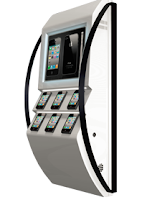
e-Passports & e-Kiosks
e-Passports:-
Different Models of e-kiosks:-
| CHS 110 |
CSH 110: CSH 110 has been developed for entities who offer collection services such as card top up and bill payments. It allows customers to make all their payments by means of banknotes, coins or credit/bank cards.
INF 130: Standing out in projects where mobility is a priority, INF 130 eliminates sharp corners to harmonise with the the atmosphere.
| INF 130 |
IDS 210: IDS 210 has been designed to showcase the product in the store with the most up-to-date information and to present it to the customers in an eye-catching way. It allows the customers to have up-to-date information of products and to compare the features of selected products at the same time.
| IDS 210 |
END 220: Designed for use not only in production facilities, but also in technical services, infrastructure units located in worksites, production and control centers in outdoors; END 220 covers the least possible area in the production. It can be easily transported and it has a design suitable for transportation by a forklift when needed.
| END 220 |
Monolith: Monolith delivers your messages wherever they may be. It draws attention of visitors by displaying company promotion videos, presentations, information announces, and similar visuals on quality displays and contributes to brand reputation.
| Monolith |
Touch Desk: Standing out with its ergonomic design, 42” Touch Desk is a unique
product to present special effects apart from its interactive
advertising, entertainment and play functions. 42” Touch Desk can be
used in many areas such as retail sales offices, stadiums, corporate
event areas, meeting rooms, stores, presentation centers, restaurants,
hotels, fairs, and interactive marketing areas.
| Touch Desk |
INF 110: Designed for places with restricted application areas, INF 100 can easily be positioned in any place, even in the narrowest areas thanks to its slender and tall structure. Modular structure of INF 110 supports the multipurpose use feature. Used for general information with its 19" touchscreen display, the Kiosk becomes suitable for advertising or CCTV by adding a second 19" display.
CHS 210: Developed for companies that offer collection services like prepayment
and invoice payments, this solution allows customers to make all their
payments by means of banknotes, coins or credit/bank cards. Thanks to
its user-friendly interface the CSH210 can perform any function normally
carried out at cashier desks.
| CHS 210 |
Subscribe to:
Posts (Atom)