Welcome

Welcome to Baqer J. Al-Lawati blog.

Wednesday, 27 March 2013

Stock Control

Stock Control

What is Stock Control?

Stock Control is the system which monitors the items in stock. Should the store run low on items, re-ordering is required.


Note that too much stock is not good for the store; nor too little is. This is due to several facts including:-

* Too much stock costs more money. Keeping too much stock could lead to 'stock overload'

Storing a lot of perishable items such as food is not a good idea as these items are going to perish sooner or later.

Having too little stock means that the store is going to run out of stock before the next delivery times.

Point-of-sale (POS) is the place where items are retailed and all transactions are made. Refunds are also done there. A POS consists of a screen, a barocde reader & a number pad (should the barcode reader goes out of order. A normal POS is called as the manual system as it doesn't keep track of stock constantly. It is not connected to a database over a netowork and hence re-ordering and update take place manually.

An Electronic Point-of-sale on the other hand is known as the automatic system. It pretty much consists of the same components as the normal POS. The only difference is that the EPOS is connected with a database. This means that most of the things are done automatically.

The whole process of the EPOS has some benefits to both the super markets & the customers. They involve:-

Goods are re-ordered automatically when stock falls under the the re-order level.

- Stock is updated after each transaction leading to a more accurate idea of stock levels.

- Questions over the bill can be resolved in a blink of an eye as a result of the itemized bill

- The use o f barcodes ensure greater accuracy and reduce errors.

In old times, retailing stores used to go counting the items in stock and ordering a large amount of items from the wholesalers. This done annually. The problems arises from the financial point of view as the company or supermarkets have to pay a substantial amount of money for the warehouse facilities and employees. Hopefully, the 'just-in-time' solves this issue as it ensures items to be delivered right where and when the company needs them.
When the stock falls under the re-order level, automatic order is being placed and therefore items get delivered without the need to store them in large warehouses. This means less fresh products are wasted and no need for high charges. 

Tuesday, 5 March 2013

Impact of ICT on Working Practices

Impact of ICT on Working Practices

 ICT has changed the world enormously in many different ways. People used to send written letters and it would take months to reach to the recieving party but today e-mails are used to deliver instant messages. From the social aspect, ICT has changed the way people used to communicate as it has introduced social netwroking sites to the world. But lets not forget on the working practices as well.


Q) How do workers experience this?

Workers' premises has been altered and  made more flexible. Workers can work remotely from home or anywhere away from their workplace. They can connect to their work's database via Virtual Private Network (VPN). This is a secure connection between the worker's PC/laptop and the company's network.

Q) How the working practices are different from the past?

Past: In the past, written documents were very common. Companies used to have a whole room for storing files. Those rooms were called as the "Registries". Companies also had to employ typists.When companies receive letters as written documents, typists would type them using a typewrite.

Today: Today, files are stored as digital format in small few hard disks and can be accessed by more than one person per time. Even documents can be word processed by clerks who can edit these documents effectively.

Old OfficeModern Office

ICT has made the world more efficient than before and work can be achieved much faster and effectively.


Teleworking

Teleworking

People have been working in their workplaces every working day and earn their salaries monthly. But there have been times when an employee cannot attend his/her workplace because of certain circumstances such as falling ill or looking after a baby. When they were incapable of coming to work, they weren't able to do their work and hence have a lot to catch up.

Today, we don't have that problem since teleworking has become common. Teleworking: Employment in home while communicating with the workplace such as a company, bank, etc... using a phone, fax, modem, etc...

With the availability of technology tools such as the internet, workers are able to work with the presence of family with the worker's home. The employee does his work from home, his manager keeps a constant check on him to make sure that the work is being done. The worker then submits his work on a specific time to the workplace. However, some employee don't recommend working from home as they don't trust themselves whether they'll manage their time well or not.


Q) What is Remote Work?

Remote Work is when someone works away from office such as a professorial going down to the petrol extraction field. He then has to report back to the workplace wirelessly. This is known as Remote Working. Another example is a case in which a doctor has to visit his patient. He'll check the situation and checks the hospital database remotely.

Q) What is a Home Based Work?

Home Based work is the usual work that is done by the workers & managers in their workplace. An obvious example is a teacher teaching in school.


Saturday, 23 February 2013

Air Conditioning

Air Conditioning

What is "Air Conditioning"?

Air Conditioning means controlling and altering the condition of air by means of cooling, heating, disenfecting, etc... to more favourable conditions. In the middle east it's used for cooling (obviously) while in cold places such as Europe, it's used for heating.

* AC is a short form for "Air Conditioning". Some people mix up between AC & A/C. A/C means "Alternate Current".

File:Heatpump.svg 


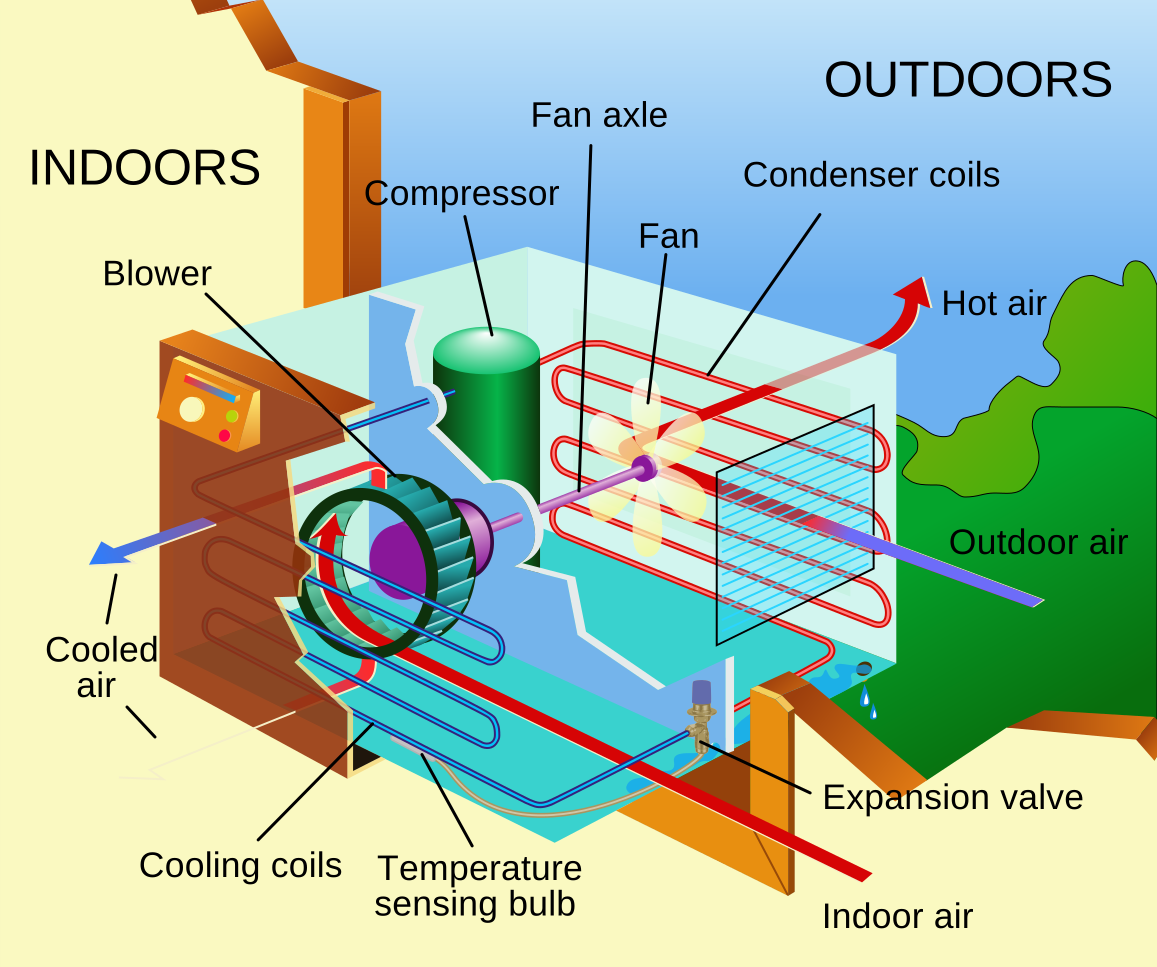
* From the cycle, we can see that low-pressure gas is compressed into high-pressure gas. The refregirant cools down to its liquid form and passes through the expansion valve which causes it to evaporate into a cold low-pressure gas. Heat is absorbed by the refregirant thus cooling the metal fins. A built-in fan blows air on to the cold metal fins causing room temperature to cool down.

File:Air conditioning unit-en.svg


Monday, 11 February 2013

Heating Systems

Heating Systems in UK


In the UK, various heating methods are provided with minimum cost. Gas is widely used in the UK as a heating method. A gas-fired boiler heats the water and to provide heat through radiators.

 A more expensive method to heat is electricity. This involves night storage heates. These use electricity to heat special retaining-heat bricks which will keep homes warm for the day.

In some remote areas where homes are short of mains gas or areas where no main gas is provided, they can always tend to use LPG (Liquid Petrolium Gas). Like the mains gas, it heats the water and provides heat through radiators. Unlike the mains gas, LPG comes in a tank which a person has to buy and could be expensive.

Similar to LPG, rural areas of the country use oil instead. It's probably the same process. Oil-fired boiler heats the water and then the water provides heat through radiators. The oil-tank can be stored above the ground as well as underground.  

 People can always consider renewable heat by means of solar-energy. It doesn't only generates its own energy but it also reduces carbon print. Renewable sources of energy are very much recommended and people who are less ddependent on sources of energy such as gas and oil are most likely to prefer using these renewable sources.


To know more about how heating systems work in cold countries, watch:-


Thursday, 7 February 2013

Types of Robots

Types of Robots in Car Manufacturing Industry

What is a robot?

A robot is a mahcine which resembles a human being (in a way) and is capable of carrying out a complex series of action.

Coming to car industry, what are the various types of industrial robots used in car manufacturing industry.

Articulated Robots: These kind of robots are greatly flexible with rotary joints. They are used to inspect areas with assembled structures. It is also ued for assmebly, wielding, weld sealing and spray painting.

Cartesian Robots: These are used for pick and place operations, assembly, handling machine tools and arc wielding. They are also called as rectangular co-ordinate robots.

Cylindrical Robots: These kind of robots operate in a cylinder-shaped space. They have a least one rotary joint and at least one prismatic joint. They are used to handle products at die-casting machine, handling machine tools and spot wielding.

Parallel Robots: These kinds of robots have multiple arms each of one has three concurrent prismatic joints. They have large working envelope but are difficult to program and control.

SCARA Robots: SCARA stands for 'Selectively Complaint Arm for Robotic Assembly.These are cylindrical and have two parallel joints. They are also used in pick and place work and assembly operations.

 Spherical Robots: These have two rotary joints and one prismatic joint. They are used to handle machine tools and arc or spot wielding.

How Robots Work in car Manufacturing?

To make a robot work, a computer program is installed on its controller computer. This provides a set of precise instructions--based on geometry and carefully timed--that tells the robot where to place things, how to rotate them, where to weld and how to perform all of its other functions. Robots do not think for themselves, and must rely on humans to provide instructions. Robots also can work in more extreme environments on their own, or they can work alongside humans, assisting them in their day-to-day jobs--such as moving or rotating a car so humans can work on parts of it that would normally be difficult to reach

 See more about robots in car wheel manufacturing:-


Read more:-

* http://www.globalspec.com/learnmore/manufacturing_process_equipment/manufacturing_equipment_components/robots_robotic_accessories/industrial_robots

* http://www.ehow.com/about_4678910_robots-car-manufacturing.html 

Tuesday, 4 December 2012

Microsoft Office Access

Microsoft Office Access

____________________

Data Base: A collection of data items and the links between them that is organised and stored so that it can be interrogated.

Field: A place used to hold a single data item within a database.

Record: A collection of field containing information about one data subject or one object within a database.

Primary Key: The key which uniquely identifies each record. It can be of a normal attribute or it can be generated by the DBMS.

Table: A two-dimensional grid organised by rows and columns within a database. Each row of the table contains a record. Each column represents a field.

Query: The primary mechanism for retrieving information from a database and consist of questions presented to the database in a predefined format.

Report: A database report presents information retrieved from a table or query in a pre-formatted, attractive manner.

Validation Rule: A rule that controls property works to require a specific value or character.

Data Types: A characteristic of a field that determines what kind of data it can store.


How to reduce entry errors?

1. Add lots of edits to programs.

2. Allow prompting on important fields for help texts.

3. Store options in tables.

4. Do not allow incorrect entries.

5. Compare entries to the table, if not there, do not update but display error message.